Artificial intelligence in the service of progress: what are the economic, social and human benefits?
Productivity, health, education, inclusion, the environment and public services: discover how AI can support progress when guided by clear objectives and human oversight.
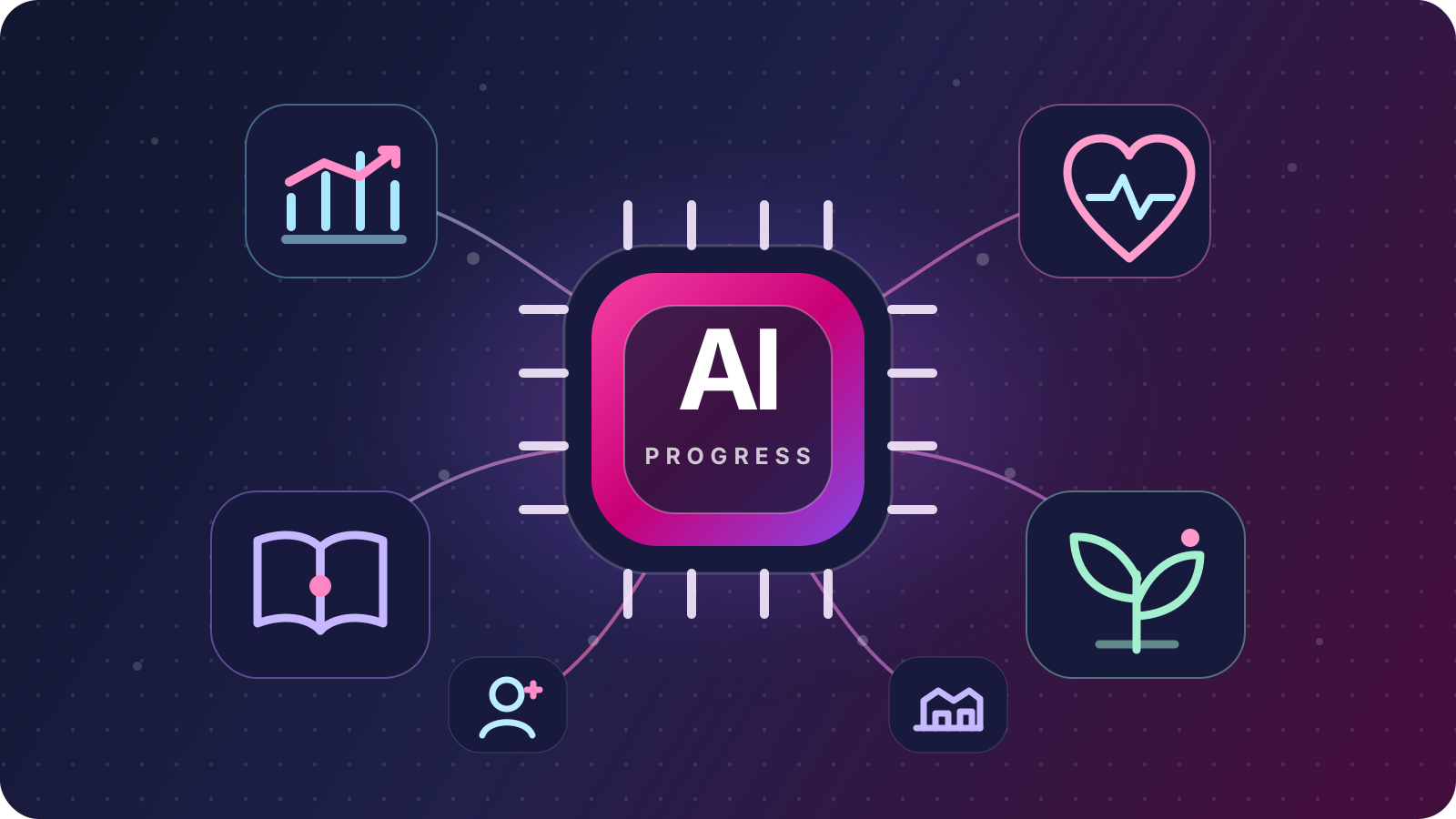
Artificial intelligence is often presented as a technological breakthrough. Yet it is more useful when viewed as a tool for development: a technology that can help people, businesses and institutions analyse information faster, make better use of their resources and make certain services more accessible.
AI does not automatically create progress. Its effects depend on the objectives it is given, the data used, the people who design it and the rules governing its use. Applied well, however, it can significantly amplify human capabilities. It can reduce the time spent on repetitive tasks, explore more options, identify certain problems earlier and offer services tailored to a wider range of people.
The potential benefits therefore extend far beyond generating text or images. They concern the economy, work, health, education, accessibility, the environment, public services, research and the ability of small organisations to innovate.
1. A driver of productivity and economic growth
AI’s first economic contribution comes from its ability to process large amounts of information quickly and automate some predictable tasks. In a business, it can help sort documents, summarise files, prepare an initial analysis, detect anomalies, answer frequently asked questions or speed up the production of a draft.
The gain is not limited to doing the same thing faster. A team can also devote more time to activities that require judgement, creativity, practical knowledge or human interaction. An accountant can focus on advice rather than data entry. A technician can intervene before a breakdown thanks to predictive maintenance. A sales team can better prepare for a conversation instead of manually searching for scattered information.
A study published by the OECD in 2025 estimates that AI could add between 0.4 and 1.3 percentage points to annual labour productivity growth in the G7 economies most exposed to AI and furthest ahead in adopting it, depending on the scenarios considered. This range is not a promise: above all, it shows that results will depend heavily on how widely the tools are actually adopted, the quality of organisation and the skills available.
AI can also improve resource use. Better demand forecasting reduces unnecessary stock. More precise planning limits empty journeys. Early defect detection reduces production losses. At scale, these improvements can strengthen competitiveness while reducing certain forms of waste.
2. Innovation capabilities within reach of more businesses
Large organisations traditionally have specialist teams in analysis, communication, research, translation, IT or design. A small business cannot always afford to maintain all these skills in-house.
AI narrows part of this gap. It can help a self-employed professional or an SME to:
- structure a market study;
- compare several business scenarios;
- translate and adapt communications;
- prepare a website or application prototype;
- analyse customer feedback;
- document a process;
- create an initial knowledge base;
- automate simple administrative tasks.
This does not replace professional expertise. It does, however, lower the cost of a first attempt. An idea can be tested faster, a prototype can be presented sooner and a small team can assess interest in a service before making a substantial investment.
This broader access is particularly important for entrepreneurship. It gives more people the opportunity to turn professional knowledge into a digital product, reach customers in several languages or professionalise an activity without having to build a large organisation immediately.
3. Work that is increasingly assisted, rather than simply automated
The employment debate often pits job creation against job destruction. In practice, change is generally more gradual: AI first transforms the tasks that make up a job.
In 2025, the International Labour Organization estimated that around one in four jobs worldwide had some degree of exposure to generative AI. It stressed, however, that job transformation was more likely than complete replacement. A job combines technical, interpersonal, physical, regulatory and decision-making tasks that cannot all be automated in the same way.
The benefits for work can take several forms:
- removal of repetitive tasks that offer little satisfaction;
- assistance with writing, research and preparation;
- improved safety through incident detection;
- faster access to internal procedures and knowledge;
- support for new employees;
- creation of new roles related to data, oversight, integration and AI governance.
For this change to be positive, productivity gains must be accompanied by training. An organisation that introduces a tool without explaining its limitations risks producing errors faster. By contrast, a team that learns to check responses, protect data and identify suitable tasks can gain autonomy and improve quality.
4. Faster scientific and technical research
Research often advances by exploring a very large number of hypotheses. AI can help identify relationships in complex datasets, simulate scenarios, classify publications or suggest avenues to test experimentally.
In health and life sciences, it can contribute to identifying molecules, analysing images or selecting candidates for further research. In engineering, it can compare shapes, materials or manufacturing parameters. In software development, it can speed up certain tests, detect errors or produce initial documentation.
The main benefit remains the speed of iteration. Researchers or engineers retain responsibility for the method and validation, but can examine more possibilities in the same time. This capability can shorten the path from an idea to a prototype and then to a usable solution.
5. Better support for healthcare
AI can contribute at several levels of the healthcare system without replacing the professional who makes the clinical decision.
It can, in particular, help to:
- analyse certain medical images;
- identify signals requiring priority attention;
- summarise a lengthy medical record;
- prepare documentation for a consultation;
- answer patients’ administrative questions;
- support medical training;
- accelerate drug research and development.
The World Health Organization identifies these uses among the potential applications of large AI models in healthcare. They offer two benefits: improving analytical capacity and reducing some of the administrative burden that takes healthcare professionals away from contact with patients.
These benefits, however, require a high level of reliability, confidentiality and oversight. A plausible but incorrect answer can be dangerous. Systems must therefore be designed for specific tasks, evaluated across diverse populations and used under the supervision of qualified professionals.
6. More personalised and accessible education
In education, AI can offer additional support between lessons. It can rephrase an explanation, suggest an exercise at an appropriate level, generate further examples or help a student identify the steps they have not yet mastered.
For teachers, it can help prepare materials, adapt exercises to different needs, translate instructions, create an assessment rubric or summarise results. The time saved can be reinvested in guidance, feedback and the teaching relationship.
UNESCO highlights the potential for broader access, personalised learning and more efficient educational management, while stressing that these tools must strengthen learners’ rights rather than create a new digital divide.
Good use therefore does not mean replacing the teacher or providing all the answers directly. It should develop understanding, critical thinking and the ability to verify information. AI is more useful as an additional tutor than as an unquestionable authority.
7. A means of improving accessibility and inclusion
Some AI applications can reduce obstacles faced by people with disabilities, older people or those who are less proficient in a language.
Practical uses include:
- automatic speech transcription;
- real-time captioning and translation;
- image descriptions for blind or partially sighted people;
- voice control of a digital service;
- simplification of administrative text;
- conversion of content into several formats;
- assistance with reading, writing or organisation;
- interface personalisation according to the user’s needs.
These technologies can increase independence, facilitate access to employment and make certain services usable without an intermediary. Their design must nevertheless involve the people concerned from the outset. A system trained on an overly uniform range of uses may misunderstand a voice, movement or way of interacting that differs from the dominant data.
Accessibility should therefore not be added at the end of a project. It must be a criterion for design, testing and evaluation.
8. Simpler and more responsive public services
Public administrations process many documents, requests and rules. AI can help direct a case to the right department, extract information, detect a missing document, translate a response or explain a procedure in simpler language.
It can also support staff by quickly finding a rule in extensive documentation or preparing a summary. Citizens then receive an initial response sooner, while staff retain responsibility for processing the case and handling exceptions.
In crisis management, analysing images, weather data or reports from the field can help map affected areas, anticipate needs and organise aid. The United Nations specifically cites crisis mapping and aid distribution among the areas where AI can support sustainable development.
Decisions that determine a right, a penalty or access to a benefit should not, however, become opaque. A person must be able to understand the process, report an error and obtain a human review.
9. Better management of energy, agriculture and the environment
AI can help observe systems that are too complex to monitor manually at all times.
In energy, it can forecast consumption, facilitate the integration of renewable sources, detect anomalies in a network and optimise equipment operation. In industry, predictive maintenance makes it possible to replace a part at the right time rather than too early or after a breakdown.
In agriculture, image and sensor analysis can help identify a lack of water, a disease or an area requiring intervention. In environmental protection, AI can support monitoring of deforestation, waste, air quality or changes in certain ecosystems.
The International Energy Agency highlights both AI’s potential to optimise energy systems and the electricity required for its own operation. Environmental benefits are therefore not automatic. They must be measured by taking account of data centre consumption, equipment manufacturing and the gains actually achieved on the ground.
10. Better-informed decisions
A complex decision often requires bringing together information from several sources. AI can help summarise the evidence, compare scenarios and flag inconsistencies.
A business can simulate the impact of a change in price, demand or lead time. A city can better anticipate the use of a service. An association can analyse the needs expressed by the people it serves. A manager can receive an alert when an indicator deviates significantly from the usual trend.
The tool should not decide in place of the person responsible. It should make assumptions visible, indicate uncertainties and allow users to return to the original data. The advantage emerges when AI broadens the scope of analysis without removing human responsibility.
11. Enhanced creativity, without uniformity
Generative AI can quickly produce variations of text, images, sound, code or layouts. It can help overcome a blank page, explore several directions and build a prototype before more expensive production.
For a creative team, the point is not to accept the first result. It is to try more approaches, combine ideas and devote more time to selection, coherence and intent. Human value shifts towards art direction, storytelling, understanding the audience and judgement.
It can also support translation and cultural adaptation, make archives easier to explore or help small organisations produce content in several formats. The risk of uniformity exists when the same tools are used without critical judgement. A strong identity still requires human choices, real experience and knowledge of the context.
12. A possible contribution to sustainable development
The United Nations estimates that AI has significant potential to accelerate progress on nearly 80% of the Sustainable Development Goals. Examples span health, agriculture, education, climate resilience and humanitarian aid.
This capability is particularly useful when human or technical resources are limited. An assisted diagnostic tool, machine translation or agricultural data analysis can make expertise available in areas where it is difficult to access.
But access remains unequal. Infrastructure, connectivity, local data, skills and computing capacity are highly concentrated. For AI to reduce gaps instead of widening them, development policies must include training, access to tools, representation of local languages and participation by the communities concerned.
The conditions for turning potential into real benefits
An organisation does not benefit from AI simply because it opens an account with a new tool. The most useful projects start with a concrete problem and measure an observable result.
1. Define a precise objective
“Using AI” is not an objective. Reducing response times, cutting classification errors or freeing up two hours a week for a higher-value task is.
2. Start with uses that involve limited risk
Summarising a meeting, searching internal documentation or preparing a draft is easier to oversee than a medical, legal, financial or social decision.
3. Retain human validation
A competent person must check the results when an error could have a significant consequence. AI should show its sources or make it possible to trace the data used whenever possible.
4. Protect data
Personal information, contracts, trade secrets and sensitive data must not be sent to a tool without understanding its terms of use, storage practices and security mechanisms.
5. Test for bias and accessibility
Results must be evaluated across varied profiles, languages and situations. The people affected by the service must take part in testing.
6. Train users
The essential skill is not just writing a prompt. Users need to know how to spot an uncertain answer, verify a source, protect data and recognise a task that should not be delegated.
7. Measure the overall result
A gain in speed can be cancelled out by more errors, corrections or frustration. Measure time, quality, cost, satisfaction, accessibility and any environmental effects.
A ninety-day plan for responsible adoption
Days 1 to 15: map the situation
- identify repetitive or slow tasks;
- identify sensitive data;
- consult the people who actually do the work;
- choose a success indicator;
- exclude decisions that are too critical for an initial test.
Days 16 to 30: prepare a pilot
- select a single use case;
- choose a suitable tool;
- define confidentiality rules;
- create a verification procedure;
- prepare a representative sample of situations.
Days 31 to 60: test
- compare the assisted process with the usual process;
- measure time and errors;
- gather users’ feedback;
- test difficult cases and exceptions;
- document the limitations observed.
Days 61 to 90: decide
- correct the process;
- train the people concerned;
- determine permitted and prohibited uses;
- plan regular monitoring;
- expand only if the benefit has been demonstrated.
What AI should not do alone
Certain functions require clear human responsibility. It is prudent not to delegate the following entirely to an automated system:
- a hiring or dismissal decision;
- a diagnosis or treatment choice;
- the granting of a right or assistance;
- a judicial or disciplinary decision;
- financial advice with significant consequences;
- management of a sensitive human situation;
- definition of an organisation’s values and strategy.
AI can prepare, research, compare or raise alerts. The final decision must remain attributable to a person who can explain and correct it.
Conclusion
The main benefit of artificial intelligence is not to replace human beings. It is to extend what a person or team can understand, create and accomplish with limited time and resources.
Used with discernment, it can support productivity, accelerate innovation, improve certain aspects of care, personalise learning, make services more accessible and help manage energy or crises better. These benefits will, however, be neither automatic nor evenly distributed.
Progress will depend on very human choices: training, including, protecting, measuring and maintaining clear responsibility. AI then becomes not an end in itself, but infrastructure serving a more efficient economy, more accessible services and development more focused on people.
Useful sources
- Macroeconomic productivity gains from AI in G7 economies — OECD
- Generative AI and jobs: 2025 update — International Labour Organization
- Ethics and governance of AI for health — World Health Organization
- AI and education: protecting learners’ rights — UNESCO
- Artificial intelligence for the common good — United Nations
- Energy and artificial intelligence — International Energy Agency
- AI for accessibility — AccessibleEU